Why Spreadsheets Fall Short in Lease Management
Why do spreadsheets fall short for commercial lease management?
Spreadsheets fall short for commercial lease management because they depend on someone remembering to check them, rather than pushing alerts before a critical date passes. Once a portfolio grows past 10-15 leases, real estate and finance teams start working from different files, which creates version conflicts and ASC 842 calculation errors that surface at audit time. A dedicated lease management system removes that manual overhead by keeping data centralized and calculations automatic.
Why Spreadsheets Fall Short for Commercial Lease Management
A real estate or finance professional who has been managing leases in spreadsheets for years knows the pattern: it worked at 5 locations, it barely works at 20, and it won't work at 50. Someone is working from an old version. A renewal deadline got missed. An auditor asked a question that took three days to answer.
That is not a discipline problem. It is a tool problem. The sections below explain exactly where spreadsheets fail and what that means in practice for commercial real estate and finance teams.
What's the best way to track lease expiration dates across multiple locations?
The most reliable way to track lease expiration dates across multiple locations is a centralized lease management system that sends automated alerts to the relevant stakeholders -- typically 12, 6, and 3 months before expiration. Spreadsheets require someone to check them proactively; a dedicated system pushes the reminder to you.
Manual critical date tracking at scale looks like this: a calendar full of reminders that someone set up two years ago and may or may not still be accurate, a master spreadsheet with 40 tabs and a note at the top that says "please update before editing," and a quarterly email chain asking whether anyone has reviewed the renewal windows coming up in Q3. When a renewal option lapses because nobody caught it in time, the cost -- a forced relocation, a market-rate renewal instead of a negotiated one -- is not recoverable.
Automated critical date tracking removes the dependency on someone remembering to check. The alerts go out. The right people see them. The action happens.
What does a company with 50 or more leases actually need to manage them?
A company managing 50 or more commercial leases needs four things spreadsheets cannot provide: automated critical date alerts, a single data source that real estate and finance teams both trust, ASC 842 compliance calculations that update when lease terms change, and the ability to answer portfolio questions in minutes rather than days.
The real cost of not having these is not measured in software fees -- it is measured in missed options, overpaid CAM charges nobody had time to audit, and audit prep that takes two weeks instead of two hours. Real estate teams spend hours each week chasing down whether a document is current. Finance teams rebuild the same amortization schedule from scratch every time a lease is amended. Leadership asks a question about portfolio exposure and gets an answer in five business days.
At 50 locations, every one of those inefficiencies compounds. The manual overhead grows faster than the team does. A purpose-built lease management system removes the overhead by keeping data current and calculations automatic, so both real estate and finance teams can focus on decisions instead of data maintenance.
How do real estate and finance teams share lease data without version control issues?
The only reliable solution is a single platform where both teams work from the same underlying lease record -- not shared folders, not emailed spreadsheets, not one team maintaining 'the master file.' When real estate updates a lease term, finance should see it immediately in the same system, not in an email attachment three days later.
Version control breaks down in predictable ways. Someone sends a spreadsheet, the recipient makes changes and saves a local copy, and now there are two versions. At month-end close, real estate's data and accounting's data don't match. Nobody knows which file is authoritative. The reconciliation takes half a day.
The same problem appears at audit time: the real estate team's lease tracker shows one set of dates, the accounting team's amortization schedule reflects different assumptions, and the auditor is asking questions that require both to be consistent. Resolving the discrepancy under deadline pressure is where errors happen. A shared platform prevents the discrepancy from occurring in the first place.
What causes lease accounting errors at audit time?
The three most common causes of ASC 842 audit errors are: lease terms in spreadsheets that have not been updated to reflect amendments, discount rates and ROU asset calculations done manually with formula errors, and missing or incomplete lease records because not all contracts were identified as leases during transition.
Lease amendments are the most common source of errors. A tenant negotiates a two-year extension on a single location. Real estate updates their tracker. Finance's amortization schedule is not updated until someone remembers to tell them -- which may not happen until the next period close. By then the schedule is wrong, the journal entries are wrong, and the disclosure is wrong.
Manual calculation errors compound across a portfolio. One wrong discount rate formula, one missed lease classification, one modification that triggered a remeasurement nobody processed -- each is a small error in isolation. Across 50 locations, the aggregate impact is material.
Incomplete lease records are the audit risk that surprises most teams. Short-term leases, equipment leases, and embedded lease arrangements are easy to overlook during the initial ASC 842 transition and stay off the books until an auditor finds them.
These are not skill gaps -- they are process gaps. A system that keeps lease data current and generates calculations automatically removes most of these failure points at the source.
What are the specific limitations of spreadsheets for commercial lease management?
The four core limitations are: no automated alerts, version fragmentation across teams, manual calculation errors under ASC 842, and no audit trail showing who changed what and when.
At what point does a company actually need lease management software?
Practically, a company should consider lease tracking software at 15-20 leases, or earlier if any of the following are true: you have a mix of ASC 842 operating and finance leases, your real estate and finance teams work from different data sources, you have missed a critical date in the last 12 months, or audit prep takes more than a week.
Portfolio size is a useful proxy, but the real signal is the overhead. If real estate and finance teams are spending meaningful time reconciling data, chasing down current lease versions, or rebuilding calculations after amendments, the cost of the manual process already exceeds the cost of a purpose-built system.
Ready to move off spreadsheets?
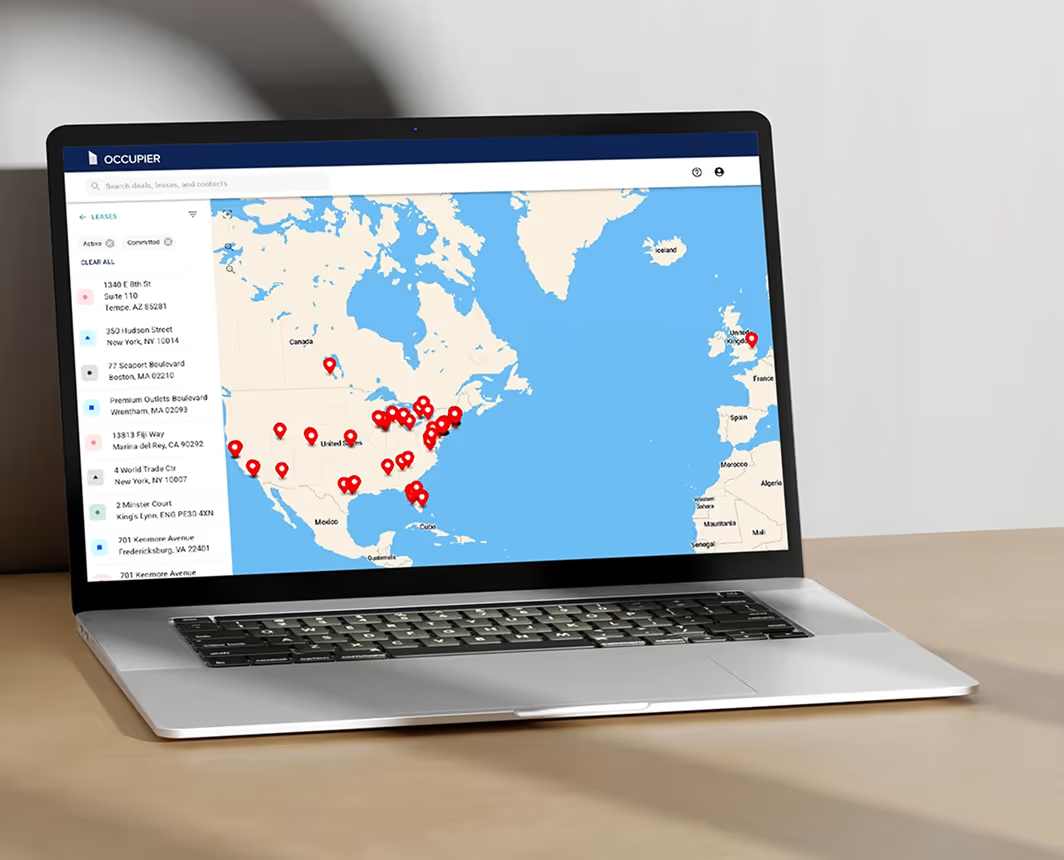
Spreadsheets can hold a lease portfolio together for a while, but they were never built to alert you, reconcile two teams' data, or hold up under an audit. Occupier gives real estate and finance teams a single, purpose-built system for lease administration, so critical dates get tracked automatically and ASC 842 calculations stay current without anyone rebuilding a schedule by hand. See how lease administration works in Occupier.
Frequently Asked Questions
Can you manage ASC 842 compliance in Excel?
Excel can perform the underlying calculations, but it cannot maintain the audit trail ASC 842 requires, automatically update calculations when a lease is amended, or generate journal entries directly from live lease data. The math is possible; the data integrity and documentation trail that auditors require are not.
How many leases can you manage in a spreadsheet before you need software?
Most real estate and finance teams find spreadsheets workable up to about 10-15 leases. Past that threshold, version control across teams, manual critical date tracking, and ASC 842 calculation complexity make the manual overhead significant enough to justify a dedicated platform.
What data does a lease management system need to store?
A lease management system stores critical dates (commencement, expiration, renewal options, rent escalation dates), rent schedules, lease clauses and special provisions, amendment history, contact information, and documents. For ASC 842 compliance, it also needs to store lease classification, discount rates, and the full amortization schedule.
How long does it take to implement lease management software?
Most implementations take 2-4 weeks for standard portfolios. Timeline depends on portfolio size, data quality, and whether the platform provides abstraction services to digitize existing leases. Uploading clean, organized data directly shortens implementation; using abstraction services for a large backlog adds time but removes internal resource burden.
What's the difference between a lease management system and a lease accounting system?
A lease management system handles the operational side: critical date tracking, rent schedules, clause storage, document management, and portfolio reporting. A lease accounting system handles the compliance side: ASC 842 and IFRS 16 calculations, ROU asset and lease liability schedules, journal entries, and audit-ready disclosures. The best platforms handle both in a single system so real estate and finance teams work from the same lease record.



Lease management that works for real estate and finance
15,000 sq ft
90 days notice
March 2026
Action required